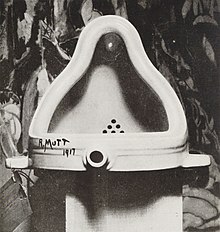
 This is a piece by Marcel Duchamp called Fountain and it is simply a porcelain urinal which is signed "R. Mutt". Along with being an example of Dada art, it is also a readymade, it challenges the viewers perception of what art is. The fact that it is a urinal might be Duchamp's response to art at the time, it being a mass-produced product of the U.S. might also be a signify to his feeling of American art and architecture. It is clear that Duchamp is displaying irreverence (such was the trademark of Dadaist) to the art world and is confronting the expectations of an art viewer. At the heart of this piece, it is a reaction to what Dada artist viewed as an absurd time.
Jacob Lawrence had a central theme to his work which was Blackness. He was very concerned with the black workforce at the time, Black History, Black celebration (Harlem Renaissance) and black education. The style of his work was influence by European Expressionism and cubism as seen in his painting The Shoemaker.The flatness of the painting and the use of bold colors is an attribute of expressionism that is used here. Also, the sharp geometric lines of the man is has an aspect of cubism in it. We also have exaggerated, elongated lines that was common in the works of artist like Kirchner.